

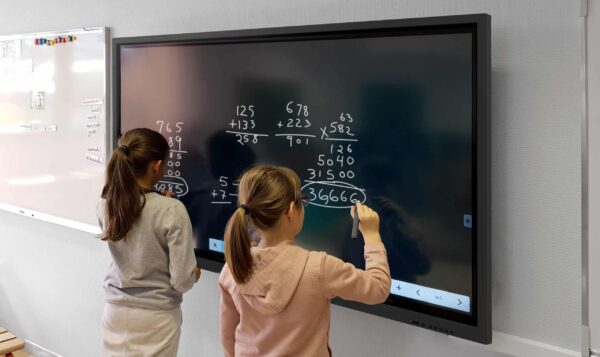
Why should you install digital whiteboards for schools, colleges and high school ? Thanks to Speechi, you will harness the power of the interactive classroom whiteboard in school and education ! The adoption of digital technology has become far more than a passing trend. In education, an interactive display can prevent school dropout ! Today, the interactive whiteboard for primary and secondary school classrooms is a powerful educational tool that supports teachers while improving student engagement and learning outcomes. Speechi develops interactive solutions designed to simplify teaching practices without increasing teachers’ workload. By placing pupils at the centre of an active and collaborative learning experience, interactive whiteboards transform classroom dynamics and modernise educational methods.
Schools require practical, reliable and flexible technology capable of adapting to different teaching environments and diverse student needs. Interactive whiteboards address these challenges by providing adaptable lesson delivery, improved classroom interaction and seamless access to digital educational resources. Speechi offers innovative solutions that help teachers optimise lesson organisation, student participation and knowledge retention.
Why use an interactive whiteboard in a classroom in primary, college and high school
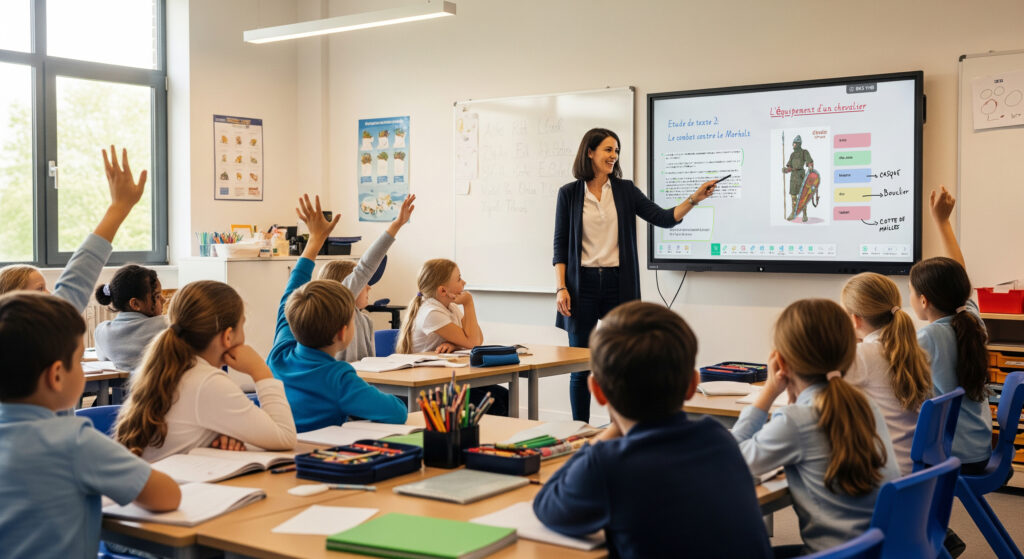
The use of an interactive whiteboard in schools fundamentally changes the relationship between teachers, students and educational content. Interactive technology replaces passive learning with a more engaging and hands-on approach where pupils can manipulate content, experiment and correct mistakes in real time.
This immediate interaction increases concentration and helps students retain information more effectively. In primary education, the visual and tactile aspects of learning become particularly important. Children understand concepts more easily by moving graphic elements, interacting with animations and participating in dynamic educational activities.
In secondary schools, interactive whiteboards provide deeper analytical possibilities by supporting the organisation of complex arguments, collaborative annotations and the analysis of multiple document sources. Speechi interactive whiteboards help schools transition smoothly towards more agile, modern and student-centred teaching methods.
By integrating these solutions into the classroom, Speechi transforms the learning environment into a collaborative knowledge hub where information flows naturally between teachers and pupils.
Main benefits observed in classrooms include:
- Increased student participation and engagement during lessons
- Easy saving, editing and sharing of educational materials
- Clearer explanation of complex or abstract concepts through visualisation. For example, you can use interactive screen for college to learn mathematics and science
- Instant adaptation of lesson content based on classroom interaction
- Direct integration of multimedia resources into teaching activities
- Interactive whiteboard activities for preschool – fun ways to keep preschoolers engaged !
How interactive whiteboards work in the school environment ?
Using an interactive whiteboard in a classroom is intuitive for teachers already familiar with computers or tablets. The system combines a touch-sensitive display with integrated software, allowing users to control lessons using either a stylus or their finger.
Teachers can display documents, highlight important information, annotate content and deliver highly interactive demonstrations in real time.
Successful adoption often comes through gradual integration. Many teachers begin by using Speechi interactive whiteboards to display familiar lesson materials before progressively exploring more advanced interactive features. This step-by-step approach encourages long-term use while avoiding sudden technological disruption.
Effective classroom management remains essential. Interactive technology should support the lesson without becoming a distraction. By maintaining constant interaction between the board and students seated in the classroom, teachers preserve group cohesion and sustain attention throughout the session.
Speechi expertise and practical educational applications
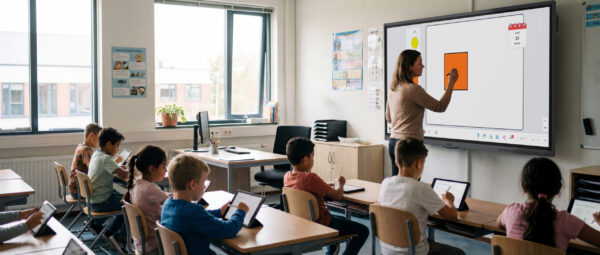
The educational possibilities offered by interactive whiteboards for primary and secondary schools extend across all subjects and teaching methods. In primary education, teachers often use interactive games and visual activities to maintain attention and motivation.
In secondary schools, Speechi tools allow educators to compare documents, cross-reference information and create advanced visual summaries that simplify complex topics.
Examples of classroom applications include:
- Mathematics: geometric constructions and step-by-step demonstrations
- Modern languages: pronunciation practice and listening comprehension exercises
- Science subjects: modelling natural phenomena and virtual experiments
- History and geography: analysis of maps, archives and multimedia sources
Formative assessment also becomes more efficient through interactive quizzes and real-time feedback. The interactive whiteboard therefore acts as a bridge between theoretical learning and practical application. With Speechi, you will be able to choose the best smart white board for schools, preschools, colleges and high schools !
Best practices for effective interactive whiteboard use
To maximise the benefits of an interactive whiteboard in schools, teacher training and support are essential. Technical mastery is only the first step; the real challenge lies in designing lessons where interactivity genuinely enhances educational value.
Preparing clear, well-structured content helps avoid information overload and maintains pupils’ attention. Effective lessons alternate naturally between explanations, interactive activities and moments of individual reflection.
Thoughtful integration of digital technology opens new educational opportunities while preserving the core learning objectives of each lesson.
Experience also shows that students learn more effectively when they actively contribute to content creation rather than simply observing presentations. By following these practical teaching principles, the interactive whiteboard has become an essential component of the modern classroom and an important driver of educational innovation.
 Teaching English in Primary School with an Interactive Display
 Interactive displays in primary school classrooms: beneficial or harmful?
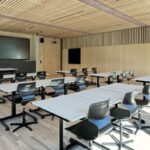 Digital whiteboards for schools, colleges and high school
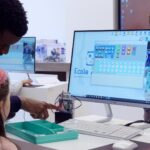 Choosing a smart whiteboard for education – Preschool, school and college
 Harnessing the power of the interactive classroom whiteboard in school and education
